The Creature’s Tale
Sometimes you stop writing because something in the world makes the act feel like a betrayal. A reflection on silence, del Toro's Frankenstein, and why showing up at the page and at the bedside is important.
INK+OXYGEN is my (mostly) weekly series from the intersection of medicine and creating. Each entry mentions something I consumed recently, a book, an essay, a movie, and ends with how it actually shows up in real life: in the ICU, at home, or in my own head. No summaries, no book reports. Just one idea, one honest application, and the next line I’m trying to draw.
This is Chapter 7.
I stopped writing for a while.
Not because I ran out of things to say. Because the saying started to feel wrong. There are stretches…and if you’ve lived them you know exactly what I mean…when people you love are somewhere you can’t reach, and the phone doesn’t ring, and the news gives you nothing you can use. You sit with it. You carry it into clinic and into the grocery store and into your kid’s bedtime routine, and the whole time there’s a frequency running underneath everything, a low hum of not knowing that makes the ordinary feel wrong.
You start a newsletter draft about VO2 max or diabetes guidelines and you think: who cares. Not because it doesn’t matter. Because the distance between what matters here and what matters there around the world becomes a gap you can’t write across.
There’s a term for this in the psychology literature. Ambiguous loss. It was developed through by Pauline Boss on work with families whose loved ones were missing in war and disaster, and the reason it’s considered uniquely painful is that it suspends you between hope and mourning. You can’t grieve because nothing has been confirmed. You can’t move forward because nothing has been resolved. You just hover. And hovering, it turns out, is exhausting in a way that action never is.
An internet blackout for days can affect a sense of loss and hovering.
I hovered for a while. And then I revisited a movie that made me pick up the Substack pen again.
Guillermo del Toro’s Frankenstein imo is not a horror film. I need to say that up front because it changes what you get into.
Btw, hope you don’t think this is a spoiler moving forward. I don’t think it is, but if you are a purist, then maybe skip this post. We can regroup on the next one.
It is a two-and-a-half-hour romantic tragedy cast in pigeon-blood red and malachite green, and it has the nerve to ask whether the real monster is the man with the degree and the funding and the laboratory.
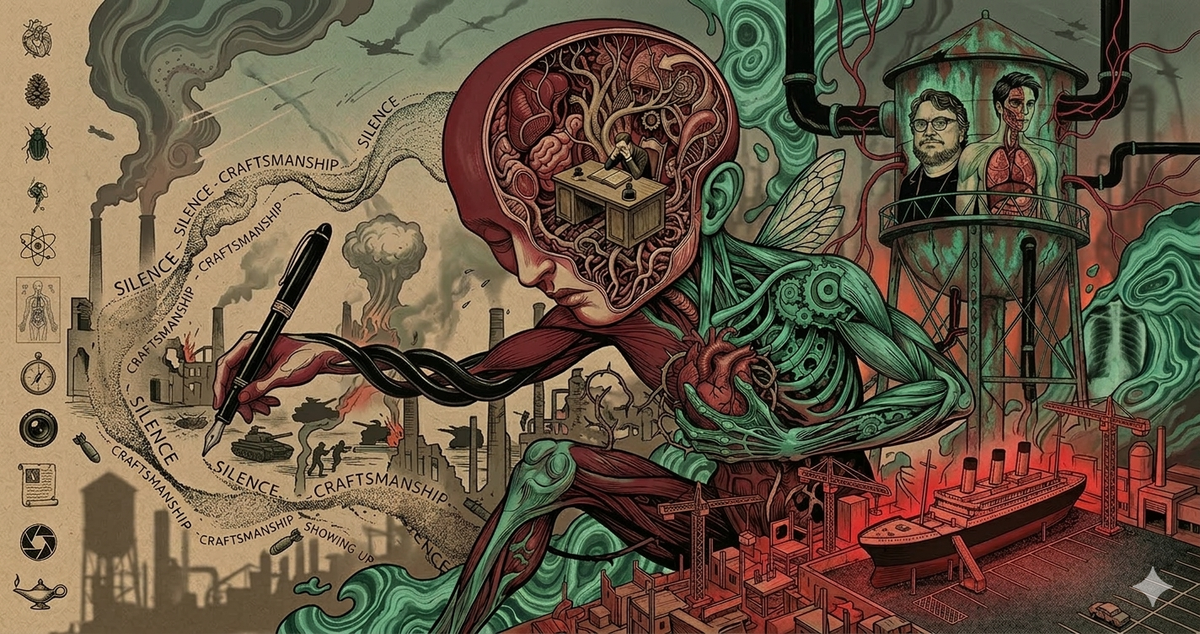
The imagery is what got me first. Oscar Isaac’s Victor lives inside a palette of black and white. Controlled, surgical, cold. His lab is Teslaean (not Musk, but Nikolai), Edisonian, steampunkish.
It sits in an abandoned water tower on the edge of a cliff, its walls coated in green patina, a metallic corrosion that the production designer called “a breathing machine.” Pipes and glass carry energy, plasma, and pulse. Notebooks, books, and body parts lie around. Everything about Victor’s world says: I built this. I own this. I understand this.
Yet immediately you understand: he doesn’t understand any of it.
Then there’s Mia Goth as Elizabeth, wearing that malachite dress. And I have to talk about this dress because it’s a crazy level of artistic and creative detail. The costume designer wove the fabric with patterns drawn from insect wings and human cells. They kept actual beetles in the studio for reference. They pulled X-rays of hip bones into the textile design. Del Toro gave every department a color code: green for life, red for blood, white for death. Absolutely striking.
Okay, well, sorry, but mild spoilers ahead.
The film splits into two perspectives: Victor’s tale and the Creature’s tale. And the contrast is the whole point. Victor is frenzied obsession. He builds and abandons. He creates life and then cannot bear to look at it. Jacob Elordi’s Creature, on the other hand, struggles to exist and his existence is a struggle. He starts as an incapable wiry adult-newborn and then becomes, through patience proximity and pain, the most articulate person in the film. He learns language from a blind man. He reads. He sits with a family he can never join and like osmosis, receives their humanity through a wall. He becomes, a better listener than the man who made him.
That’s what wrecked me. Not the gothic spectacle.
The listening.The hand on the head. The pat on the shoulder.
In the ICU, you learn early that there are two kinds of silence. There’s the silence of a stable ventilator at 3 AM. The vent breathing, the monitor tracing, the patient sedated, everything holding. That silence is a gift. You can think inside it. You can plan.
Then, there’s the other silence. The one after a family meeting where you’ve said everything you can say and there’s nothing left but the weight of the whole thing. The silence when the phone call to the next of kin goes to voicemail. The silence when you know the prognosis but the family isn’t ready, and so you just sit in it together, and sitting is the work.
The Creature knows this silence. He lives in it for the entire middle of the film. He doesn’t get to participate in the family’s life. He witnesses it through a wall. And somehow that witnessing is enough to make him human. More human, frankly, than Victor, who has every advantage and uses none of them for connection.
Elizabeth.
I think about this in medicine more than I should. The physicians who change outcomes, and I don’t mean mortality data, I mean the whole fabric of a patient’s experience, are not always the ones with the most impressive procedural volume. They’re the ones who sit down. Who listen past the chief complaint into the thing the patient actually came to say. That’s a kind of craftsmanship that doesn’t show up in any metric, and it’s the thing that makes you a physician instead of a technician.
Del Toro understands this. When asked about making the film, he said he wanted real sets. Not digital, not AI, not simulation, not CGI. But old-fashioned craftsmanship: people painting, building, hammering, plastering. One hundred days of shooting. One hundred and nineteen sets built by hand. A full-size ship constructed in a parking lot. In an era where you can generate anything on a screen, he chose to build it with his hands.
That’s bedside medicine.
That’s also, I think, what writing is supposed to be.
Here’s what I’ve decided about the guilt.
It’s not vanity. It’s a moral emotion…the kind that shows up when your sense of responsibility outgrows your actual power. You feel it in the ICU when a patient codes and you did everything right and it still wasn’t enough. You feel it when the world is on fire, like right now, and you’re writing about fountain pens or rowing intervals. The feeling says: this is wrong, you should be doing something. But the feeling doesn’t specify what. And that’s the trap. Because the unspecified obligation brings paralysis, and paralysis brings silence, and silence doesn’t help anyone…least of all the people you’re silent for.
Publishing is not moving on. It’s staying human enough to keep showing up. The page, like the bedside, asks for your presence, not your perfection. It asks you to sit with what you know and what you don’t know and to make something from the space between them. That’s the Creature’s lesson. He didn’t wait until he had all the language. He started with what he had: fragments, sounds, a few books, and then he built from there.
Del Toro spent nearly two decades dreaming about this film. He could have kept dreaming. Instead, he built 119 sets and put a ship in a parking lot.
I don’t want simulation. I want the real thing. - Guillermo del Toro
So here I am. Back at the page. Hands on the keys instead of hovering over them. The hum is still there (it doesn’t really go away with all of this news) but I’ve decided that writing through it is better than writing around it, and both are better than not writing at all.
Doctor’s Order
The craft doesn’t ask you to be whole.
Like the gym, nutrition, and every other bit of improvement, it asks you to simply show up.