Have You Ever Wondered…the Medicine & Science of Losing Your Temper?
This Teaching Edition explores what happens in the brain and body when anger takes over the nervous system, how to bring it back online as a physician, parent, and human.
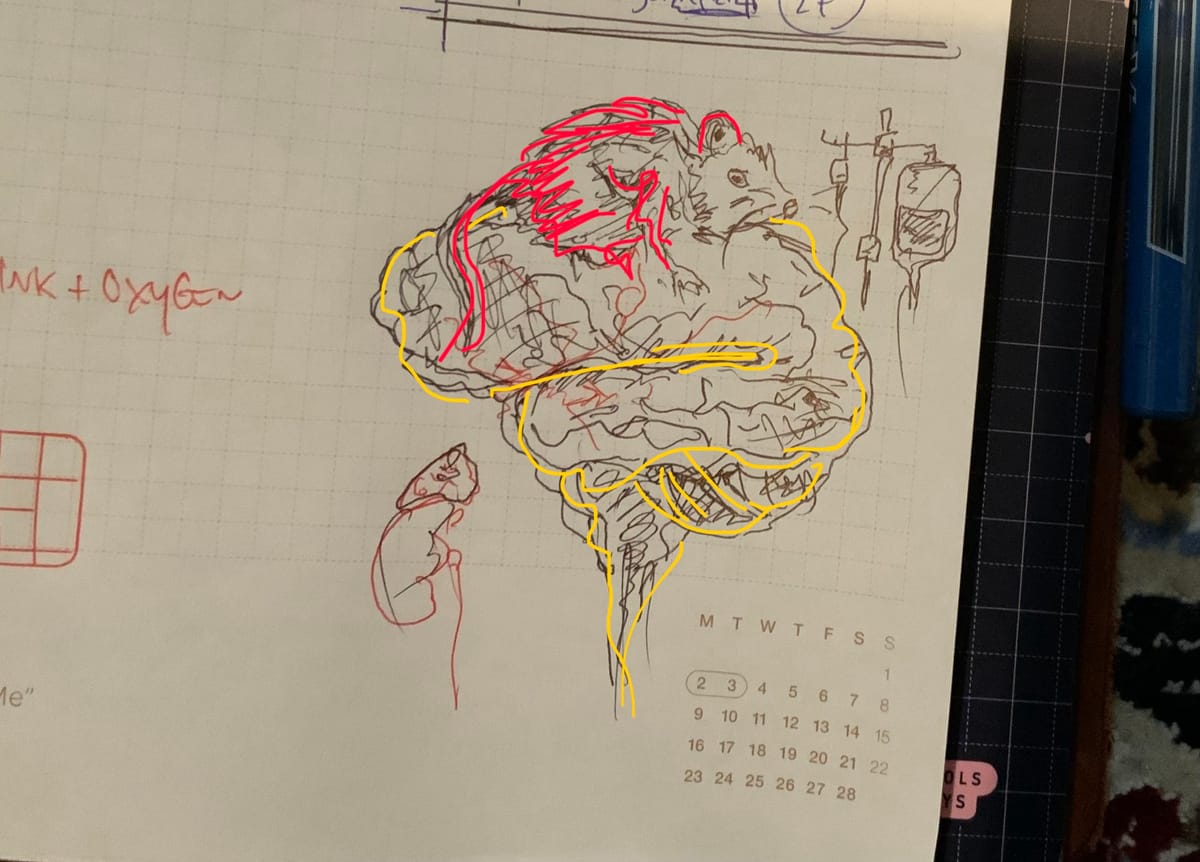
This Teaching Edition explores what happens in the brain and body when anger floods the system, why your frontal lobe goes dark in real time, and how to bring it back online as a physician, a parent, and a person. And credit to Crucial Conversations for the rodent brain visual.
The Angry Brain is an ICU Brain. -Me
You’re mid-conversation. Within seconds, the mercury rises inside your throat, warming each vertebral level as it climbs. Heart pounding. Palms clammy. Mouth dry. Eyes scanning for words. And suddenly you’ve lost yourself.
Silver tongued you may be. But not now.
What just happened? Who am I? I just want to focus.
You remember Jefferson Fisher: pause. Deep breath. Hold. Count. Hold. Exhale. Resting breath.
But why the escalation. Why now.
…because this is a crucial conversation.
And if you’ve read Crucial Conversations, you already know the punchline:
When the conversation turns crucial, we do not rise to our ideals. We fall to our training.
That line is leadership. But it’s also our biology.
THIS IS NOT A FLAW
This is not weakness. Not you being “too intense.” This is your nervous system switching operating systems.
Two triangular glands atop your kidneys release just enough epinephrine, in just the right aliquots, to ruin your timing. Enough to narrow attention. Dry your mouth. Make your hands sweat. Enough to turn your nuanced frontal lobe into something smaller, older, faster.
A rodent brain.
That’s not an insult. Rodents are built for speed: fast detection, fast reaction, minimum to zero deliberation.
Fight. Flight. Freeze. Bite. Hide. Repeat.
Your amygdala lights up. Sympathetic tone spikes. Muscles prime. Vision narrows. You feel the urge to interrupt, control, punish, win. Your body prepares to jump out the window or attack a lion that isn’t there.
Meanwhile, the part of you that loves nuance, timing, moral reasoning, restraint, the part that prides itself on being elegant in speech and precise in thought, begins to dim. The prefrontal cortex doesn’t vanish. It just sort of stops.
Under threat, the brain prioritizes survival over sophistication. So yes, you can still speak. Still drive. Still see patients. Still parent. But your capacity for wise dialogue, curiosity, self restraint, timing, for being the adult in the room, gets impaired. A partial blackout.
Afterward, when the flood recedes, you look back at what you said and think: who wrote that?
This is why anger is so disorienting. It’s not only an emotion but a real state shift.
THE ANGRY BRAIN IS AN ICU BRAIN
When an ICU patient decompensates, the body makes brutal triage decisions. Everything is a contest of urgency, priority, and triage within and amongst the cells, tissues, and organs. Blood flow and energy go to what keeps you alive now. Everything else waits.
Anger does something similar.
It burns glucose. Shifts blood flow. Narrows the lens. Changes the goal from effective to victorious.
That’s how you can win an argument and lose a relationship in the same minute.
THE SCIENCE: WHAT IS ACTUALLY FIRING
A (somewhat) simplified neuroanatomy wiring diagram.
- Threat detection and meaning
The amygdala (basolateral and central nuclei) tags the moment as threat. The anterior insula and anterior cingulate cortex generate the felt sense of urgency, especially when the threat is social: disrespect, rejection, humiliation, loss of control. - The fast autonomic surge
The hypothalamus and brainstem coordinate the sympathetic response. The locus coeruleus floods the cortex with norepinephrine, sharpening attention but narrowing it into a tunnel. The periaqueductal gray coordinates defensive behaviors. The sympathetic chain increases heart rate, contractility, and sweating. The adrenal medulla adds epinephrine. Your body is ready for action before your mind even knows what is going on. - The slower endocrine wave
The HPA axis adds cortisol on a slightly slower timeline, sustaining vigilance and amplifying reactivity. Sleep deprived, underfed, overcaffeinated, or chronically stressed? Oye, that is no good. - Why your “adult brain” goes offline
Under high arousal, the prefrontal cortex (dorsolateral and ventromedial regions) loses bandwidth. Top down inhibition weakens. Working memory shrinks. Nuance collapses. You get faster, not wiser. Less executive control, more reflex. You’re getting ready for flight. - How you get it back
A long exhale increases vagal influence and engages baroreflex pathways. Not Bro-science. Physiology. Slowing the breath and widening the visual field reduces the tunnel signal and helps restore prefrontal control. Naming the emotion recruits language networks and re-engages frontal circuitry. You are rebuilding cortical authority in real time.
Ah, so #5 is lungs and naming emotion… -Me
THE TRIGGER FACTORY
In medicine, we live inside one. C’mon now. You’d be naive to think that inpatient environments can breed toxic cultural sentiment by overworked and over pressured healthcare workers.
A consultant dismisses you. A nurse caught in a broken system lets frustration spill sideways. A terrified family goes accusatory. A trainee misses something obvious. An administrator says, “Just document better.”
The pager won’t stop. Sleep debt stacks on shift work stacks on decision fatigue.
Your brain reads the moment as threat. Your body gears up to protect. And if your mouth follows, well, then afterward: nothing but wreckage and rumination.
I was supposed to be the calm one. Grounded. Objective.
And parenting? Parenting levels up harder. Because parenting adds love. Unconditional love makes the threat feel existential. A child refuses shoes and your adult brain interprets it as loss of control, loss of competence, loss of identity.
Suddenly you’re not teaching shoes. You’re defending your worth.
That’s when the rodent brain wins.
THE SAVING GRACE
Anger is predictable. It has a signature, a time signature, a body signature. Most people just haven’t learned to read their rhythm.
The tells are jaw tight, heat in the face, voice getting sharp, speeding up, interrupting, a need to be right, a need to punish, tunnel vision, the fantasy of teaching them a lesson. If you catch the first ten seconds, you avoid the next ten minutes.
An important thing to remember: “calm down” doesn’t work.
Calm down is a cortical instruction, but in anger your cortex is underpowered. Telling an angry brain to calm down is like telling a drowning person to breathe normally. You don’t argue your way out of physiology. You regulate your way out.
THE REAL QUESTION
Look it’s not about “how do I never become angry.” But the question we have to ask ourselves is “how do I keep my frontal lobe online when my body is ready to fight a demon that doesn’t exist.”
The most dangerous moment is the moment you don’t name what’s happening.
I’ve heard that idea phrased a few different ways. I remember it from Recapturing the Growth Track, and I remember it again from The Courage to Be Disliked.
Name the emotion. If you don’t name it, it becomes yours. - Ken Utech
If you don’t name the emotion in the room, you start carrying it. If someone projects their fear or anger and you pick it up, it becomes yours. Then you’re arguing with their nervous system using yours.
This is harder than it sounds, and it’s taken me long to understand it. Because the above is not conversation. It’s contagion.
It’s not my task to carry the emotion someone else throws at me. It’s my task to stay in my lane, keep safety intact, and show up as myself.
Not the rodent.
WE FALL TO OUR TRAINING
So you train.
Think of it like building healthy muscle. Anyone can move weight with sloppy form. You can yank the bar, heave, cheat, win the rep. But you pay for it: strain something, teach bad mechanics, build strength on a crooked foundation.
Clear muscle development requires tension under control, in other words, clean form.
Temper is the same.
The goal is not to be soft. The goal is to be strong with clean form.
AN APPROACH
- Name the state. Out loud if you can.
“I’m getting activated.” “I’m getting frustrated.” “Give me ten seconds.” “Let me think.”
Avoid intellectualizing. Naming recruits the circuits you’re trying to bring back online. - Lower the physiologic stress. Not a speech. A physical downshift.
Long exhale. Shoulders drop. Jaw unclenches. Widen your gaze. Feel your feet.
Six breaths where the exhale is longer than the inhale.
You’re telling your adrenals, “there is no lion in the room.” - Buy time with a clean pause.
As a doctor: “I want to get this right. Let me review the data. I’ll call you back.”
Or: “Let’s kindly keep this respectful. Allow me to reintroduce myself.”
As a parent: “I love you. I’m taking two minutes. I will be right back.” - Tell the truth without the threat.
I love this quote and I’m not sure where it’s from: Anger loves the sword. Truth doesn’t need one.
“I’m concerned we’re missing evolving shock.”
“I need you to see the patient now.”
“I need a clear recommendation.”
“I need cooperation because we’re going to be late.”
“I can handle your feelings.”
Firm. Clean. No extra anger. - Ask the question that saves you.
What outcome do I want in two hours, two days, and two years.
DOCTOR’S ORDER
This week, let’s not aim for less anger. Instead, let’s aim for a faster return of the frontal lobe. Less rodent. More human.
Thanks for reading this one. With gratitude — BOKA